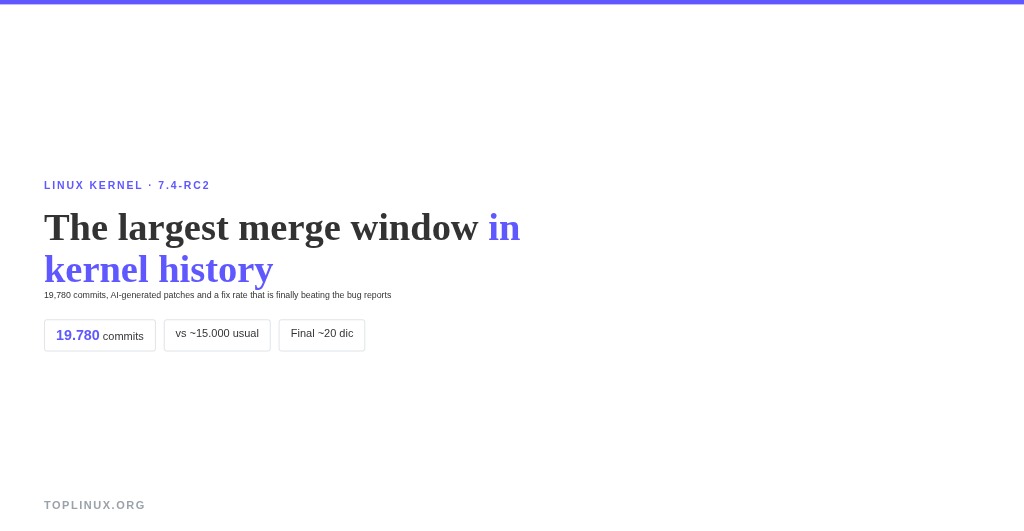
Linux 7.4-rc2 is out: a big rc2 to go with the largest ever rc1. 19,780 commits, FAT32 improvements, AMDGPU HDMI 2.2 fixes and AI-generated patches that are finally outpacing new reports.
Linus Torvalds released Linux 7.4-rc2 on 8 November, and the announcement contains a sentence that sums up the whole cycle: “a big -rc2 to go with the largest ever -rc1.”
If you follow kernel development, that matters more than any single feature in this release candidate. The 7.4 merge window pulled in 19,780 commits between the v7.3 tag and 7.4-rc1 — against the usual ~15,000. The previous record, Linux 6.7, sat at 16,203 by the same count.
What actually landed in rc2
Torvalds describes the diffstat as “fairly benign”. Stripping out the noise, the shape is familiar: roughly a third is drivers (GPU, networking and sound account for most of it), a third is networking and BPF, and the last third is filesystems, memory management and architecture updates.
The concrete items worth knowing about:
- FAT32 gets a real improvement, particularly with synchronous mounts — one of those quiet fixes that only matters to the people who were hitting it.
- AMDGPU fixes for HDMI 2.2 FRL, plus tweaks to AMD’s PerfOpt feature for Radeon integrated graphics performance.
- A fix for faulty BHI mitigation selection in some kernel configurations — a security-relevant correctness bug.
- Numerous fixes for what Torvalds calls “nasty long standing bugs” in the core memory management code.
The AI part is no longer the story, and that is the story
Much of the rc2 work was driven by AI-generated fixes and bug reports. Torvalds has stopped flagging it each time: “I think I’ll stop repeating that, and we can just take it for granted.”
The interesting detail is a status report from the BPF side. Alexei Starovoitov claims that, in that subsystem at least, fixes are now arriving faster than new reports. Torvalds is careful about it — “that sounds lovely if true” — and notes most other areas have not reached that point yet. But he reads it as a sign the tide may be starting to turn.
That is a meaningful shift. For the past year the open question about AI in kernel development was whether it would drown maintainers in plausible-looking patches. A subsystem where the fix rate exceeds the report rate is the first concrete evidence that it might not.
When 7.4 lands
If the usual seven-release-candidate schedule holds, Linux 7.4 final should arrive around 20 December, or a week later if an eighth rc is needed. There is also a widely held assumption that 7.4 will be the next LTS series — which, as Torvalds points out, is itself one of the reasons the merge window got so big.
What to do with this
Nothing yet, for most people. An rc2 is not for your daily machine: it is for testers, distribution maintainers and anyone hunting regressions. Your distro decides which kernel it packages and when it validates it.
If you do want to test it, build from Linus’s git tree or grab a mainline build from your distribution’s testing repository — and keep a known-good kernel installed so you can boot back into it.
Be the first to leave a comment