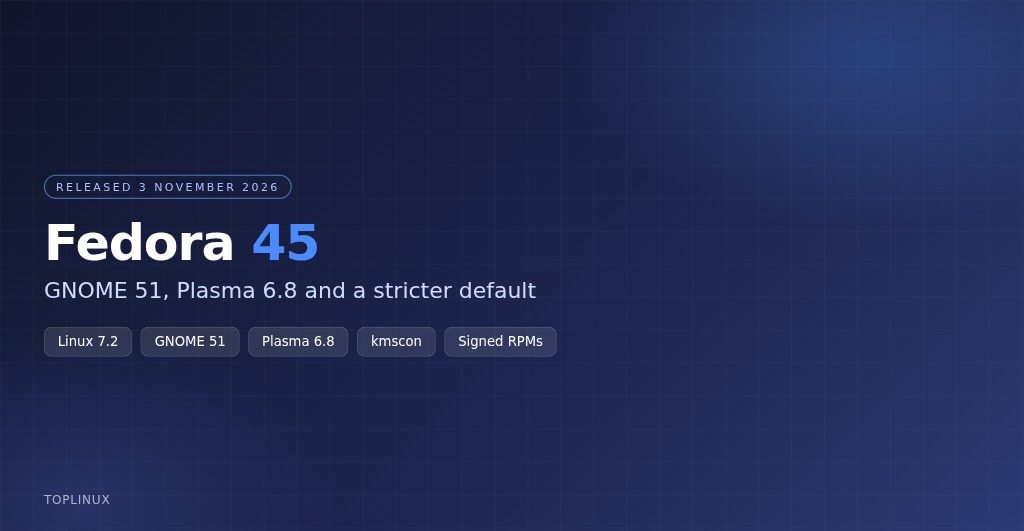
Fedora Linux 45 arrives with GNOME 51, KDE Plasma 6.8, the Linux 7.2 kernel, kmscon replacing fbcon, enforced RPM signature verification and restricted ptrace by default.
The Fedora Project released Fedora Linux 45 on 3 November 2026, two weeks later than planned: the release missed its original 20 October target after a pair of last-minute no-go decisions. What arrived in the end is a solid, unspectacular release — and in Fedora’s case, that is meant as a compliment.
This is the version that replaces Fedora 44 across Workstation, the KDE Plasma edition and every spin. Here is what changed, and what it means if you run Fedora on a desktop or a workstation.
What is in the box
The short version: Linux kernel 7.2, GNOME 51 on the flagship Workstation edition and KDE Plasma 6.8 on the KDE spin. Around that, a set of security changes that matter more than the desktop polish.
GNOME 51: smaller changes, better felt
Fedora Workstation 45 ships with GNOME 51. The headline items are not features you can point at, but the kind of refinements you notice after a day of use:
- Smoother animations thanks to improved frame scheduling.
- Faster screen capture.
- Better display management, with automatic screen rotation on compatible devices.
- Monitor brightness levels that are remembered between sessions.
- An option to disable the touchpad automatically when an external mouse is connected.
GNOME Software also gets useful touches: warnings for applications that are no longer maintained, more detailed Flatpak permission information, and faster browsing through the catalogue. GNOME Maps can now download maps for offline use, and the file previewer has been redesigned on GTK 4 and libadwaita.
KDE Plasma 6.8 and the end of the X11 session
The KDE Plasma edition moves to Plasma 6.8, which introduces per-screen virtual desktops — each monitor can keep its own workspaces. There is also a system tray toggle for switching between light and dark themes, microphone testing, and improved remote desktop performance with bidirectional clipboard synchronisation and virtual display support.
The significant line in the changelog is quieter: Plasma 6.8 retires support for launching a native X11 desktop session, completing its move to Wayland. X11 applications keep working through XWayland, but the old session type is gone.
Under the hood: kmscon replaces fbcon
One of the less visible changes is also one of the more interesting. Fedora 45 replaces the traditional in-kernel virtual console, fbcon, with kmscon, a userspace implementation. The practical payoff is a console with better Unicode and font rendering, more reliable keyboard layout handling, and less console code running inside the kernel — which is exactly the kind of thing you want moved out of the kernel.
Security: stricter by default
Two changes stand out, because both alter behaviour rather than adding options:
- RPM signature verification is now enforced by default. Packages must carry valid signatures and digests before installation, unless verification is explicitly overridden.
- ptrace permissions for unprivileged users are restricted by default, which makes it harder for a malicious application to inspect other processes belonging to the same user. Full debugging remains available, but it has to be enabled deliberately.
For a distribution that many people use as a daily driver, tightening defaults is the right direction: the safe path is the one you get without reading any documentation.
How to upgrade
Fedora 45 is available for download from getfedora.org, as a fresh install or as an upgrade from Fedora 44 using the standard dnf system-upgrade workflow. As always: back up first, and if you rely on proprietary drivers or on a specific X11 session, check the release notes before you pull the trigger.
Should you upgrade?
If you are on Fedora 44, this is a normal, well-behaved upgrade cycle — nothing forces your hand, but nothing argues against moving either. The case for doing it now rests on the security defaults: signed packages and restricted ptrace are the kind of changes you want on your machine sooner rather than later.
Fedora’s role in the Linux ecosystem has always been to be the place where changes show up first. Fedora 45 is a good reminder that “first” does not have to mean “fragile”: this is a release that moves the platform forward without asking you to babysit it.
Be the first to leave a comment